
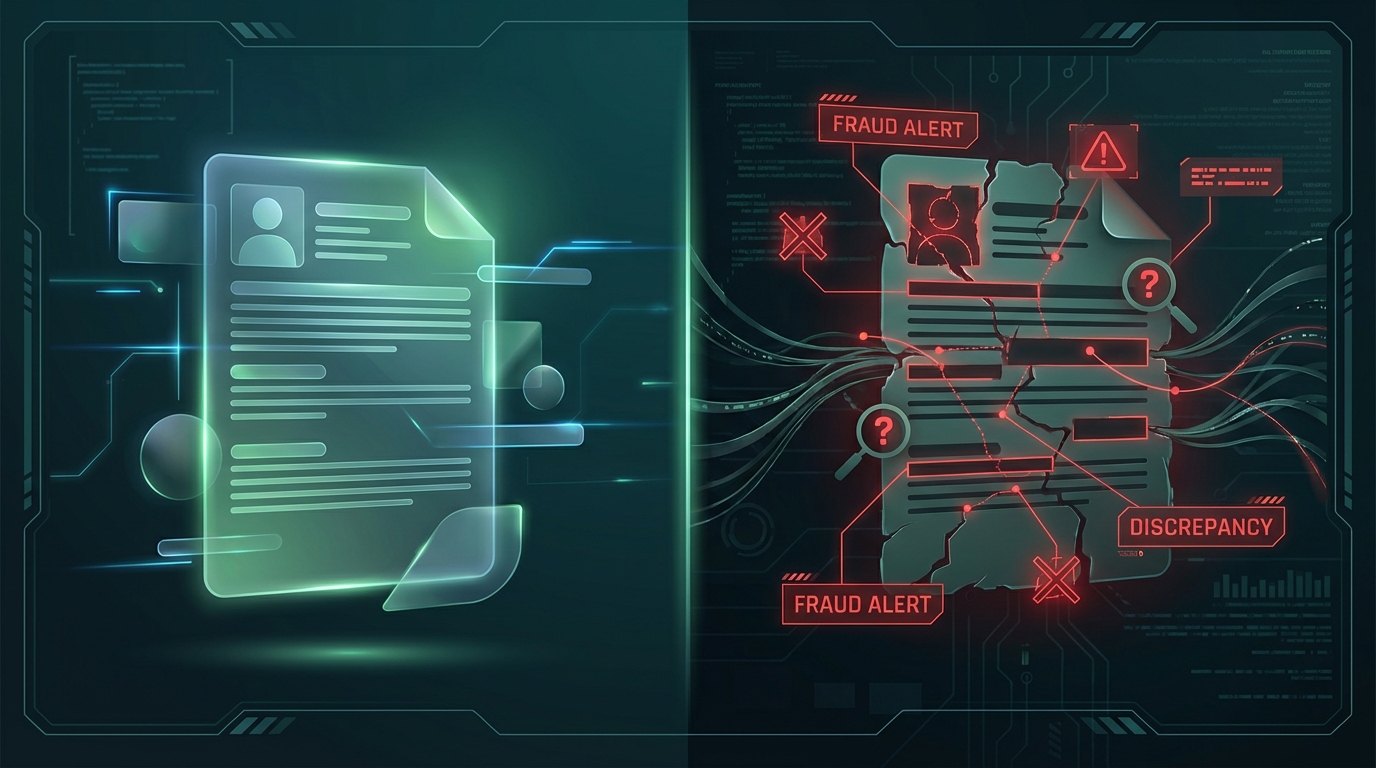
The problem is no longer if candidates lie. It’s how sophisticated the lies have become.
A recruiter’s instinct used to be enough. You’d scan a CV, catch a few inflated titles, notice a suspicious gap, and move on. That worked when the biggest threat was a candidate who rounded up their years of experience.
That era is over.
In 2025, 91% of recruiters reported spotting candidate deception during the hiring process. Not the occasional exaggeration — systematic, AI-assisted misrepresentation that’s getting harder to catch by the day.
The numbers that should keep every headhunter up at night
Let’s start with what we know:
- 72% of candidates have lied about their skills on their resume (Standout-CV)
- 28% of candidates now admit to using AI to generate fake work samples (Greenhouse)
- 59% of hiring managers suspect candidates of using AI tools to misrepresent themselves (Checkr)
- 25% of all job applications could be fake by 2028 (CloudApper)
And the most common lies? Employment dates (43%), years of experience (40%), education credentials (33%), and specific skills (30.8%). These aren’t small embellishments. They’re the exact data points you rely on to make placement decisions.
From embellishments to deepfakes: a new category of fraud
Here’s where it gets alarming. We’re no longer talking about a candidate who says “Advanced Excel” when they mean “I can make a pivot table.”
Experian named deepfake job candidates one of the top fraud threats for 2026. The methods now include:
- AI-generated resumes tailored to match specific job descriptions with fabricated project histories and skill claims
- Deepfake video interviews where real-time face-swapping and voice cloning allow one person to impersonate another
- AI-powered interview assistants that feed candidates answers during live video calls
- Synthetic identity packages complete with fake LinkedIn profiles, fabricated references, and AI-generated portfolio work
A 2025 Checkr survey of 3,000 hiring managers found that 65% have caught applicants using AI deceptively — including scripts, prompt injections, and deepfakes. And 34% of recruiters now spend up to half their week filtering spam and junk applications.
This isn’t a future problem. It’s a Tuesday.
The financial damage is real
When a fabricated candidate slips through, headhunters don’t just lose credibility — they lose money.
- A single bad hire costs at least 30% of the employee’s first-year salary (Apollo Technical)
- The average cost of detecting a proxy hire is $28,000 per incident (Metaview)
- 23% of hiring professionals reported losses exceeding $50,000 in the past year due to hiring fraud (Checkr)
- In a 100-person company with 10% turnover, the annual cost of bad hiring decisions reaches $700,000 (SkillFinder Group)
For headhunters working on contingency fees of 20-30% of first-year salary, a single bad placement can wipe out months of revenue — and the replacement guarantee call from your client is the call nobody wants to take.
Why traditional screening fails against AI-enhanced fraud
The fundamental problem is asymmetry. Candidates now have access to AI tools that can generate hyper-tailored resumes in seconds, while most recruiters still screen the same way they did five years ago.
Traditional keyword-based ATS screening? It’s exactly what these AI-generated resumes are optimized to beat. The candidate’s AI reads your job description and generates a CV that mirrors it perfectly — right keywords, right structure, right buzzwords. A perfect match on paper. A disaster in practice.
Manual screening? With an average of 2,500+ applications per role and 70-80% of applicants not meeting basic qualifications, no human can maintain the pattern-recognition quality needed to catch sophisticated fraud at scale.
The old approach of “I’ll know it when I see it” breaks down when what you’re seeing has been engineered by AI to look exactly like what you want.
The case for radical skepticism
This is where the recruitment industry needs a fundamental shift in mindset. Not from skepticism to trust — but from casual skepticism to radical skepticism.
What does that mean in practice?
Don’t take a CV at face value. If a candidate claims “Python,” look for the proof in their work history. If it’s missing, flag it. If they list “Led a team of 15” but their previous title was “Junior Developer” three months earlier, that deserves a question.
Cross-reference everything. Skills listed in the summary should exist in the work history descriptions. Education claims should align with graduation timelines. Job titles should match the level of responsibilities described.
Focus on evidence, not keywords. A resume that matches your job description perfectly should raise more suspicion in 2026, not less. Real candidates have messy, authentic career stories. AI-generated profiles are suspiciously clean.
This is the approach that separates a stack of CVs from a verified shortlist. It’s the difference between summarizing what a candidate claims and scrutinizing whether those claims hold up.
Fighting AI with AI — but the right kind
The answer isn’t to abandon AI screening — it’s to use AI that thinks like a senior recruiter, not like a keyword matcher.
The right AI screening tool should:
-
Validate skills against evidence. If a candidate lists Python as a skill, does their work history show projects where they actually used it? If not, that’s a red flag, not an oversight.
-
Detect inconsistencies across the timeline. Career jumps that don’t make sense, title inflation that contradicts the described responsibilities, education gaps that don’t align with claimed certifications.
-
Check constraints, not just keywords. Does the candidate actually have the required degree? Do they speak the required language? Are they in the right location? These non-negotiables need hard verification, not fuzzy matching.
-
Show its work. When AI flags a concern, the recruiter needs to see why — the specific evidence or lack thereof. Black-box AI that says “this candidate scored 72” is useless. AI that says “Missing Evidence: Candidate claims 5 years of AWS experience, but no role in their history mentions cloud infrastructure” gives you something actionable.
-
Generate interview questions that probe gaps. The best screening doesn’t end with the CV — it prepares you for the conversation. “You list Intermediate English. Please describe your daily usage in your last role” is worth more than a thousand keyword matches.
This is exactly what Terna does. It doesn’t summarize resumes — it scrutinizes them, flagging missing evidence, inconsistencies, and red flags so you can build shortlists you actually trust. Currently in invite-only beta at terna.cc.
What this means for headhunters in 2026
The resume arms race is not slowing down. As generative AI tools become more accessible and more sophisticated, the gap between what candidates can fabricate and what recruiters can detect will only grow — unless recruiters adopt tools designed specifically for verification.
Here’s the uncomfortable truth: your competitors who adopt AI screening will catch what you miss. And in a market where a single bad placement can cost $28,000 and your reputation, the cost of not adapting is higher than the cost of change.
The headhunters who thrive in this environment will be the ones who:
- Treat every CV with the same healthy skepticism regardless of how polished it looks
- Use AI as their senior analyst — handling the tedious cross-referencing so they can focus on the human elements AI can’t replace: empathy, cultural fit assessment, relationship building
- Deliver verified shortlists to clients — not a stack of keyword-matched resumes, but candidates whose claims have been scrutinized and validated
Because in the end, “La Terna” — that final shortlist of the top three candidates — only means something if those three candidates are actually who they say they are.
Key takeaways
- 91% of recruiters have spotted candidate deception — AI-generated fraud is now mainstream
- 72% of candidates lie about skills; 28% use AI to generate fake work samples
- Deepfake interviews and synthetic identities are a top fraud threat for 2026 (Experian)
- A single bad hire costs 30%+ of first-year salary; fraud detection costs $28,000 per incident
- Traditional keyword-based screening is exactly what AI-generated resumes are optimized to beat
- The solution: Radical Skepticism — AI that cross-references claims against evidence, not just keywords
Sources
- Greenhouse - What Is Candidate Fraud and How Can Recruiters Prevent It
- Checkr - The Hiring Hoax: What 3,000 Managers Revealed (2025)
- Standout-CV - Resume Lies Study
- CloudApper - The Recruitment Trust Crisis (2026)
- Experian - 2026 Fraud Forecast
- Apollo Technical - The Cost of a Bad Hire
- Metaview - Candidate Fraud Detection
- SkillFinder Group - The Hidden Cost of a Bad Hire
- Malwarebytes - Deepfakes, AI Resumes, and Fake Applicants
- Fortune - Job Applicants Using Deepfake AI
- The Markup - Hiring in an Era of Fake Candidates